By QuoteIron TeamUpdated 11 min read
Key takeaways
- The book’s three sample plumbing rates are $75, $95 (the default) and $125 an hour. They are sample rates, not a market survey.
- Build your own: (take-home + overhead) ÷ billable hours. Illustration: ($72,000 + $23,000) ÷ 1,000 hours = $95 an hour.
- BLS lists a $30.67 median hourly wage for plumbers, pipefitters and steamfitters (May 2025). That is an employee wage, not a billing rate.
- The rate moves parts-heavy jobs very little: a first-hour diagnostic is $85, $105 or $135, and a 50-gallon electric water heater replacement is $1,255, $1,325 or $1,430.
- Give after-hours work its own line: $205 at $95/hour, $100 more than the $105 first-hour call.
Related: How much should an electrician charge per hour · How much should a handyman charge per hour · How to price a water heater replacement · plumbing price book guide · plumber flat-rate price book
This guide is for the plumber setting the rate, not the customer reading one. It does three things: shows how to build an hourly rate from your own numbers, shows what that rate becomes on real jobs from QuoteIron’s plumbing book (priced September 2026), and covers how a solo plumber should handle hourly versus flat pricing, the service-call fee, after-hours calls and the “your rate is high” objection. Every dollar figure in the job tables is the book’s formula at a stated sample rate: hours × rate, plus parts at cost with a 30% markup, rounded up to the next $5.
Which sample rate fits which kind of shop is our reading of the three numbers, not a survey of what plumbers charge:
| Sample rate | Who it tends to fit (our reading) |
|---|---|
| $75/hr | New solo plumber: lower overhead, still building a customer base |
| $95/hr (book default) | Established solo plumber with a full week of repeat work |
| $125/hr | Licensed shop with a helper, a second van and real overhead to carry |
Build your hourly rate from your own numbers
An hourly rate is not a number you look up. It is what you must bill for each hour you actually sell so the year pays you, pays the business and leaves a margin. The formula is: (what you need to take home + what the business costs to run) ÷ the hours you can realistically bill.
Here is an illustration, with assumptions stated, not a recommendation. Suppose an established solo plumber wants a $72,000 take-home target. Annual overhead comes to $23,000: van and fuel $10,000, liability insurance and license costs $6,000, tools, drain camera and PPE $3,500, and phone, software and permit paperwork $3,500. That is $95,000 to cover. If the plumber can realistically bill 1,000 hours a year (the rest goes to driving, quoting, supply-house runs, callbacks and paperwork), the rate is $95,000 ÷ 1,000 = $95 an hour, which happens to be the book’s default sample rate.
Change one assumption and the answer moves. A new solo plumber with a $52,000 take-home target, $14,000 of overhead and 880 billable hours gets ($52,000 + $14,000) ÷ 880 = $75 an hour, the book’s starting-point rate. The number most people get wrong is the billable hours: a 2,000-hour year does not produce 2,000 billable hours. For the same method with other assumptions, see how much an electrician should charge per hour and how much a handyman should charge per hour; for a first-year version see pricing jobs as a new solo tradesman.
Parts are separate. Your hourly rate prices your time; the 30% markup on materials prices the supply-house run, the warranty risk and the money tied up in stock. Keep labor hours and materials cost as two different numbers on every job, the way the book does.
What the government says plumbers earn, and why it is not your rate
The U.S. Bureau of Labor Statistics publishes wages, not billing rates. In its May 2025 Occupational Employment and Wage Statistics (OEWS) data, shown on the BLS Occupational Outlook Handbook page for plumbers, pipefitters, and steamfitters (SOC 47-2152; page last modified October 29, 2026, read November 9, 2026), the median hourly wage is $30.67 and the median annual wage is $63,800.
Those are what employers pay an employee for an hour of work. They do not include the employer’s payroll taxes, insurance, van, tools, license, supplies, idle time or profit, which is exactly the list your rate has to cover. That is why a solo plumber’s billing rate sits well above the wage figure, and why quoting a customer your “hourly wage” undersells the business. Use the BLS figure as a sanity check on your take-home target, never as the rate.
For billing-rate ranges, read them as context. A construction-software company’s guide, Bridgit’s plumber hourly rate article (dated September 2026, read November 9, 2026), lists billed rates of $45 to $200 an hour nationally, with most jobs at $75 to $150. Another company’s range is not your cost base, and QuoteIron’s $75, $95 and $125 are book samples, not an average of what plumbers charge.
What your rate turns into on real jobs
Here are eight plumbing jobs from the book at all three sample rates. Hours and parts are the book’s typical starting points; the price is hours × rate plus parts × 1.30, rounded up to $5.
| Job | Hours / materials | At $75/hr | At $95/hr | At $125/hr |
|---|---|---|---|---|
| Plumbing diagnostic visit, first hour | 1h / $5 | $85 | $105 | $135 |
| Locate and repair a minor visible leak | 1.5h / $20 | $140 | $170 | $215 |
| Clear kitchen sink drain clog | 1.25h / $10 | $110 | $135 | $170 |
| Clear main sewer line from cleanout | 2h / $25 | $185 | $225 | $285 |
| After-hours, weekend, or holiday emergency call, two-hour minimum | 2h / $10 | $165 | $205 | $265 |
| Replace kitchen faucet, new faucet included | 1.25h / $190 | $345 | $370 | $405 |
| Replace toilet, standard height, new toilet included | 1.5h / $230 | $415 | $445 | $490 |
| Replace 50-gallon electric water heater | 3.5h / $760 | $1,255 | $1,325 | $1,430 |
Look at how little a rate change moves a parts-heavy job. The first-hour diagnostic is $85, $105 or $135, a spread of $50. A kitchen faucet replacement with the faucet included is $345, $370 or $405, a spread of $60; a standard toilet with the toilet included is $75 apart across the three rates; and a 50-gallon electric water heater replacement is $175 apart, because most of that price is the tank. A customer comparing two plumbers’ hourly rates is usually comparing a few dozen dollars.
The rate matters most on jobs that are mostly your time. Clearing a kitchen sink drain is 1.25 hours and $10 of materials: $110, $135 or $170, a $60 spread. Clearing the main sewer line from the cleanout (2 hours) runs $185, $225 or $285. Whichever mix you carry, set the rate first and the book follows. The book has no standalone additional-hour line for plumbing, so bill an extra hour at your rate ($95 at the default) and write it on the quote.
Hourly or flat rate for a solo plumber
Hourly billing is simple to explain, but it asks the customer to trust that your hours are fair, and it caps you at the speed you work. A flat-rate price book prices each repeatable job once, from your rate, hours and markup, so the customer hears a single number before you start and you keep the gain when you get faster.
- Use flat rates for repeatable work: faucets, toilets, disposals, water heaters, drain clears, valves, sump pumps. The book above is exactly that.
- Use an hourly line for open-ended work that grows once the wall is open: a hidden leak, a failing drain line, a repipe surprise. Say the rate and the hours estimate on the quote.
- Use a diagnostic first when the problem is unknown: the first-hour diagnostic visit prices your time to find it, with the repair quoted separately.
For how to set up a whole book this way, read flat rate pricing for contractors and how to build a flat-rate price book, and see QuoteIron’s ready-built plumbing price book guide and plumber flat-rate price book. For a big job priced the same way, how to price a water heater replacement walks through it.
“The rate matters most on jobs that are mostly your time.”
Service calls, after-hours emergencies and permits
You do not need a separate rule for these. In the book they are ordinary lines, so the price is visible and the customer can see why.
- First hour and minimum. The plumbing diagnostic visit, first hour, is $85, $105 or $135. That line is your minimum for showing up. A locate-and-repair for a minor visible leak is 1.5 hours: $140, $170 or $215.
- After hours. Nights, weekends and holidays are their own line with a two-hour minimum: $165, $205 or $265. At the default rate that is $100 more than the $105 weekday first-hour call.
- Diagnostics that need equipment. Electronic leak detection for a slab or concealed line is 2.5 hours: $270, $320 or $395. A camera inspection of a sewer line is $120, $150 or $195.
- Permits. Permit pull and inspection coordination is its own line (1.5 hours and $55 of fees and supplies): $185, $215 or $260. Fees vary by city, so check your own city or county and list the line separately so the customer sees it is not padding.
Putting after-hours on its own line, rather than quietly raising your rate, keeps the weekday rate clean and makes the premium something the customer chose when they called.
Offer three options: Good, Better, Best
On a clogged-drain call, a customer will usually choose from a clear menu faster than they approve a single number. Build the three options from lines already in the book, at the $95 sample rate:
| Option | What is in it | Price at $95/hr |
|---|---|---|
| Good | Clear the kitchen sink drain clog | $135 |
| Better | Good plus a camera inspection of the sewer line ($150) | $285 |
| Best | Better plus clearing the main sewer line from the cleanout ($225) | $510 |
Better is the Good price plus the camera line ($135 + $150), and Best adds the main-line line ($285 + $225). Each line is priced separately in the book and rounded up to $5, so adding them gives the totals shown.
When the customer says your hourly rate is high
- “Your hourly rate is high.” Move the conversation from the rate to the job. On a one-hour diagnostic the spread between the book’s lowest and highest sample rate is $50; on the 50-gallon water heater replacement it is $175.
- “The other plumber quoted less per hour.” Ask what the quote includes: the diagnosis, the permit line, the return trip. A lower hourly number with extra lines is not a lower price.
- “Can you knock something off?” Offer the Good option rather than discounting your rate. Cutting the rate cuts your pay on every job that follows.
- “Why a service-call charge?” Because the first hour pays for the drive, the tools and the diagnosis, whether or not the repair goes ahead. It is a priced line, not a surprise.
- “Why more after hours?” Because the customer called at night and you left your evening. It is its own line with a two-hour minimum, stated before you roll.
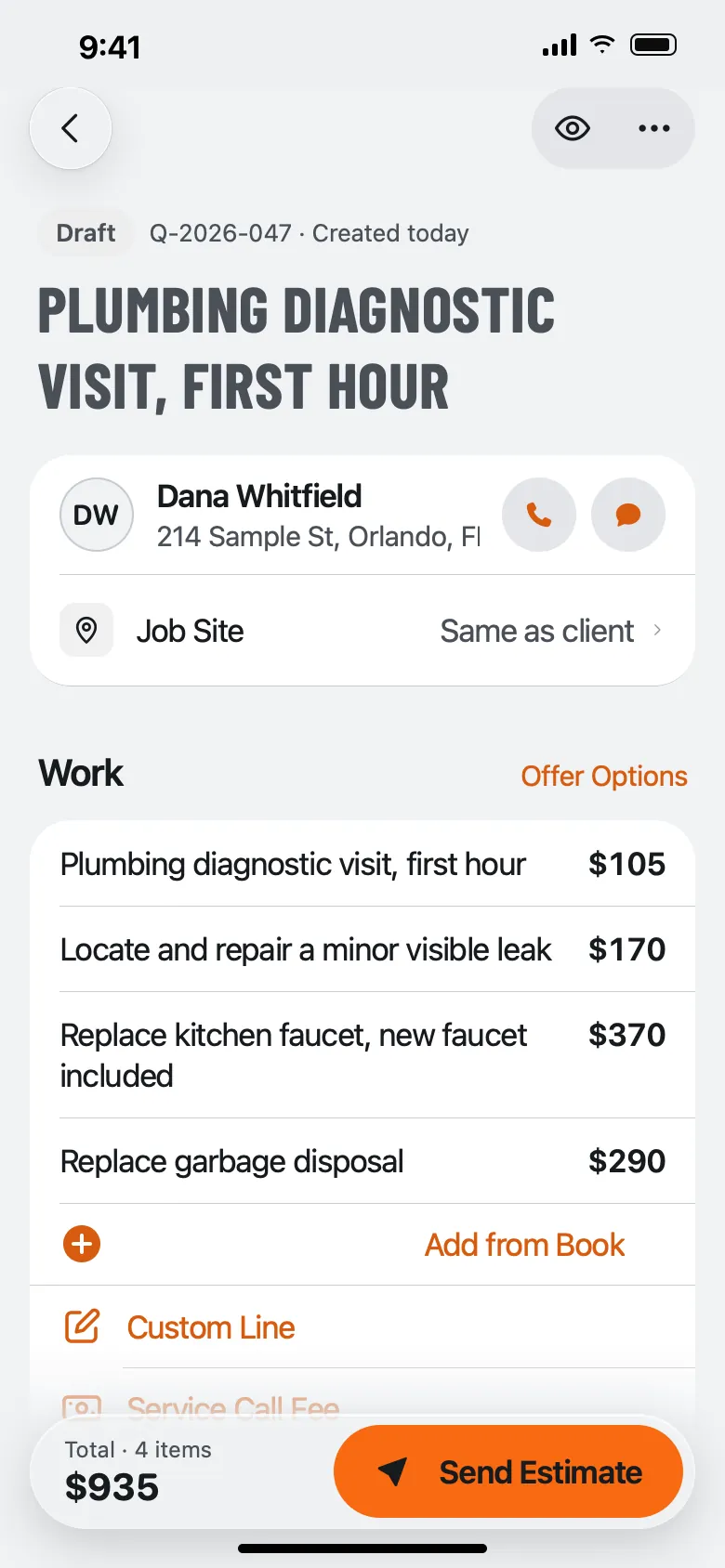
How to put your rate into a quote in about two minutes
- Work out your real rate with the formula above, then set it once, along with your parts markup and rounding.
- Open the plumbing book and pick the job: diagnostic, drain, faucet, toilet, water heater or valve.
- Add the lines that apply: permit, after-hours, a camera inspection or a haul-away.
- Send the quote. Change the rate later and the whole book reprices.
Sourced facts above: BLS Occupational Outlook Handbook (May 2025 OEWS) and the Bridgit rate guide, both read November 9, 2026. Prices checked November 9, 2026 against QuoteIron’s price book (priced 2026-09). The three hourly rates are sample rates, not a survey of what plumbers charge; your market, license, supplier and costs decide the real number. Not legal, tax or licensing advice.