By QuoteIron TeamUpdated 11 min read
Key takeaways
- Flat rate is one fixed price for a defined job: labor hours × your rate + materials × 1.30, rounded up to the next $5. A garbage disposal swap at $95 an hour is $290; a ceiling fan swap is $175.
- From $75 to $125 an hour moves an AC capacitor from $80 to $115 and a two-car driveway from $205 to $330; parts-heavy jobs move less.
- You carry the slow job: on the disposal, a 2-hour job leaves $80 an hour after parts against $160 if it takes one hour; break-even against a $95 rate is about 1.7 hours.
- Use an hourly line or labor block for diagnostics and unknown scope: the first-hour service call is $85, $105 or $135 and a half-day block is $320, $400 or $520.
- Offer Good, Better, Best scopes ($340, $480, $730 for a ceiling fan) instead of discounting your rate.
Related: How to build a flat-rate price book · Pricing jobs as a new solo tradesman · The $15.99 flat-rate price book you actually own · handyman flat-rate price book · free book builder
Most tradesmen start on the clock and drift toward flat prices after a few jobs where the fast one earned less than the slow one. This guide covers the pricing model, not how to build a whole book (that is how to build a flat-rate price book). Every dollar figure below comes from QuoteIron’s price book: typical hours times a sample hourly rate, plus parts with a 30% markup, rounded up to the next $5. They are formula outputs, not a market survey.
What flat rate pricing is, and how it differs from hourly
| Model | What the customer sees | Who carries a slow job | Best for |
|---|---|---|---|
| Flat rate | One price for the defined job, agreed before you start | You do | Repeat jobs you can scope: swaps, repairs, cleanings |
| Hourly | A rate times the hours on site, plus parts | The customer does | Work you cannot scope until you open it up |
| Time and materials | Labor hours and parts, itemized, usually with a markup on parts | The customer does | Long or changing jobs, remodels, repairs with unknowns |
The difference that matters is who carries a slow job. Hourly and time-and-materials put the clock on the customer; flat rate puts it on you, and pays you for being fast and prepared. Other guides frame the same model: Jobber’s academy page (last modified August 7, 2025, read October 27, 2026) builds a flat rate as base cost plus a profit margin, with examples at a 20% margin, and Service Fusion (published August 25, 2026, read October 27, 2026) layers overhead at 30% and profit at 20% on top of labor and materials. QuoteIron’s book takes a simpler route: overhead goes into your hourly rate once, and materials carry their own markup.
The formula, and the rate behind it
Every line in the book is one calculation: (labor hours × hourly rate) + (materials cost × 1.30), rounded up to the next $5. Your rate comes first. A workable rate is take-home pay plus overhead divided by the hours you can realistically bill; the price book guide’s illustration is ($70,000 + $18,000) ÷ 1,000 hours = $88 an hour. Plug in your own numbers; this article uses $75, $95 and $125 as three samples.
Take the garbage disposal swap at $95 an hour. Labor is 1.25 hours, which is $118.75. Parts are $130 and the 30% markup is $39. That adds up to $287.75, which rounds up to $290. The ceiling fan swap is 1.5 hours ($142.50), $25 of parts and $7.50 of markup: exactly $175. Notice where the money sits: on the disposal most of the price is parts and markup, on the fan it is almost all labor, so the rate matters more on one than the other.
Seven repeat jobs, priced at three rates
| Book line | Hours / parts | At $75/hr | At $95/hr | At $125/hr |
|---|---|---|---|---|
| Replace AC run capacitor (HVAC) | 0.75 h / $15 | $80 | $95 | $115 |
| Replace ceiling fan, existing fan-rated box | 1.5 h / $25 | $145 | $175 | $220 |
| Replace garbage disposal | 1.25 h / $130 | $265 | $290 | $330 |
| Replace toilet | 2 h / $195 | $405 | $445 | $505 |
| Clean gutters, single-story home | 2 h / $5 | $160 | $200 | $260 |
| Pressure-wash two-car driveway | 2.5 h / $12 | $205 | $255 | $330 |
| Paint one room, walls only, up to 12 by 12 | 5 h / $85 | $490 | $590 | $740 |
Read across a row and you see what your rate does. From $75 to $125 an hour the AC capacitor moves from $80 to $115 and the two-car driveway from $205 to $330, because labor is most of those prices. The toilet moves from $405 to $505 because $195 of the job is a fixture. Read down a column and you see why a book beats a calculator in the truck: the answers are already worked out. The jobs come from the handyman, HVAC and pressure washing books; the same job can have a different line in each trade’s book. See the handyman price list for fifty-plus more, or the HVAC and pressure washing books.
The same job, flat versus hourly
| If the job takes | Flat rate: customer pays | Flat rate: you keep per hour after parts | Hourly at $95 plus parts at cost: customer pays | Hourly: you keep per hour after parts |
|---|---|---|---|---|
| 1 hour | $290 | $160 | $225 | $95 |
| 1.25 hours (as booked) | $290 | $128 | $248.75 | $95 |
| 2 hours | $290 | $80 | $320 | $95 |
This is an illustration built on the book’s disposal line: 1.25 hours and $130 of parts. On the hourly side, the customer pays $95 an hour plus parts at cost (no markup), so you keep $95 an hour no matter how it goes. On the flat side, $290 less $130 of parts leaves $160 for the labor: $160 an hour if you finish in one hour, $128 as booked and $80 if it takes two. The break-even against a $95 hourly rate is about 1.7 hours ($160 ÷ $95). Flat rate pays you for knowing the job; it costs you when the job is not the one you priced.
“Flat rate pays you for knowing the job; it costs you when the job is not the one you priced.”
When flat rate loses
- Diagnostics. You cannot price a repair before you know what is broken. The book prices the first hour of an electrical service call and diagnostic at $85, $105 or $135 for the three sample rates; sell that hour, then quote the fix.
- Troubleshooting with open scope. The book’s “troubleshoot dead outlets or tripping breaker” line is 1.5 hours and $10: $130, $160 or $205. It is a time box, so write what happens if the cause runs past it.
- Rewires, hidden damage and old buildings. If the answer is behind a wall, use a labor block. The handyman book has a half-day block (four hours) at $320, $400 or $520, and a full day at eight hours.
- Customer-supplied parts. You carry the labor risk but lose the materials markup, and the install is not under your parts warranty. Say so on the quote.
A useful test: if two of your last five jobs of this type ran more than a quarter longer than the book, the line is wrong or the job is not a repeat job. Fix the hours or move it to a block.
How to present it
Show the job name, what is included and the price, not the hours and parts. A customer who sees “1.25 hours” starts pricing your minutes. Three habits make flat prices easier to say out loud:
- A minimum. The book’s first-hour service call is $85, $105 or $135 for the three sample rates. It covers the drive, setup and an hour of work, so a ten-minute fix still pays for the trip.
- Written exclusions. Write what the price does not cover: hidden damage, code upgrades, customer-supplied parts, access problems.
- Good, Better, Best. Offer three scopes of the same job and let the customer choose a scope instead of a discount. Ceiling fans work well:
| Option | What is in it | Price at $95/hr |
|---|---|---|
| Good | Replace the fan on an existing box (electrician line) | $340 |
| Better | Install the fan with a new brace box | $480 |
| Best | Install the fan where no light exists today | $730 |
The Better and Best prices are their own book lines, not Good plus extras, so the shared setup time is already in them.
Objections you will hear
- “What is your hourly rate?” Answer with the job: “This one is $290 all in. If it goes long, that is on me.” Do not give a rate you have to defend by the minute.
- “It only takes an hour.” The price covers the van, the parts run, the license, the insurance and the warranty as well as the hour. That is the same answer whether you finish early or not.
- “The other guy is cheaper.” Ask what his price includes: the part, the haul-away, the return trip if it fails. Compare lines, not totals. If it really is the same scope, he may be charging for less.
- “Just do it hourly then.” If the scope is unknown, agree: use a labor block. If it is a standard swap, explain that a fixed price means they know the cost before you start.
- “Can you knock something off?” Offer a smaller scope (the Good option) rather than a lower rate, so the price stays tied to the work.
Common mistakes
- Pricing from what a competitor charges instead of your own rate, hours and parts.
- Leaving travel, setup and cleanup out of the hours.
- Skipping the markup on parts, then paying for trips to the supply house with your own time.
- Never checking the book against real jobs. Log actual hours on your next ten repeats of one job and correct the line.
- Quoting unknown scope flat, then eating the hidden problem.
How to quote it in QuoteIron
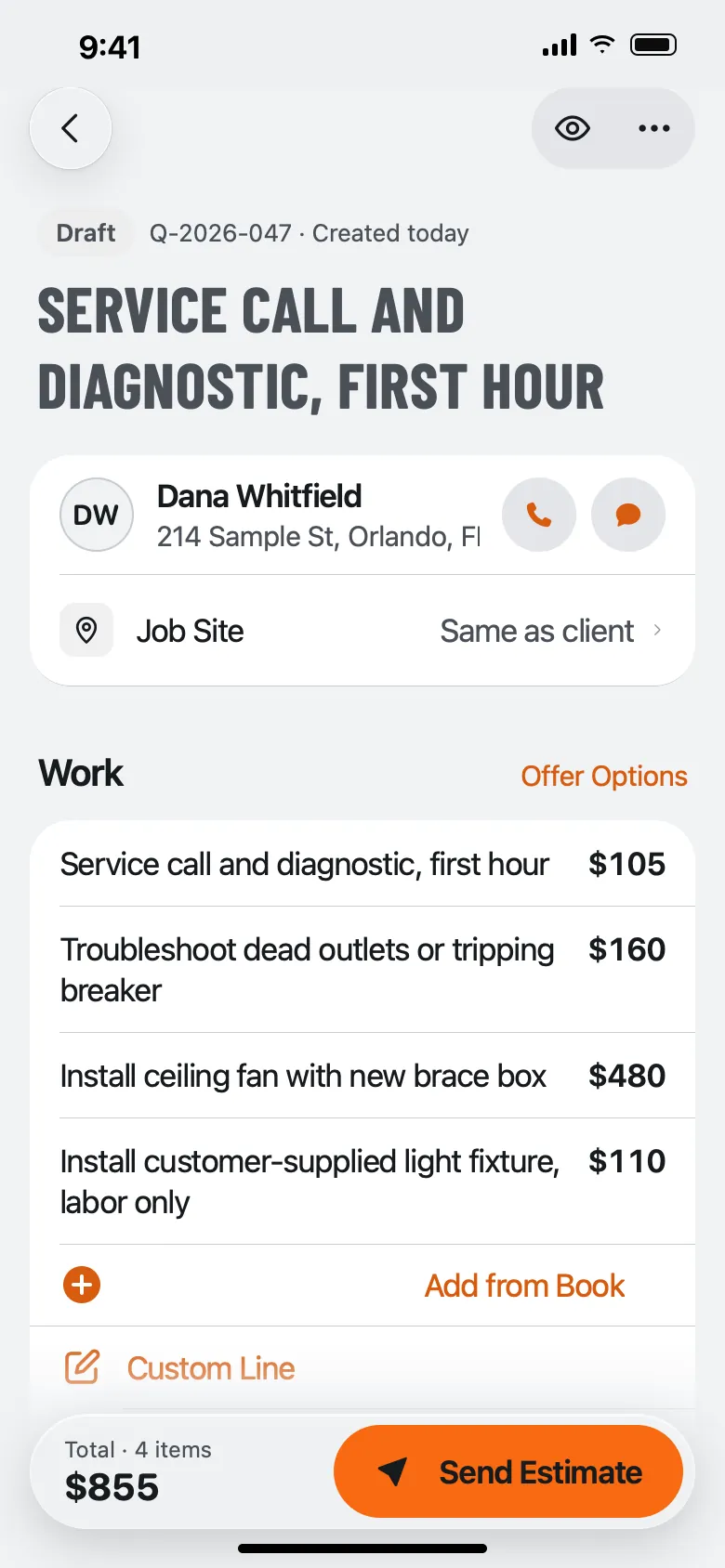
- Open Settings and enter your hourly rate and your materials markup once. The book ships at a 30% markup; change it if yours is different.
- Pick the job template for your trade: the app has 1100+ of them, each with typical hours and parts already filled in.
- Check the price. If a line is off for your market, edit its hours or parts; the price recalculates from your rate.
- Add a minimum line or a Good, Better, Best set if the job calls for it, and write your exclusions.
- Send the quote to the customer from your phone. When it is accepted, take the payment by card through your own Stripe account.
Prices from the QuoteIron price book at three sample labor rates, 30% materials markup, rounded up to $5; checked October 27, 2026. The flat-versus-hourly table is an illustration built on the book’s disposal line, with parts at cost on the hourly side. Reference pages: Jobber Academy (last modified August 7, 2025) and Service Fusion (published August 25, 2026), both read October 27, 2026. Not tax or legal advice.